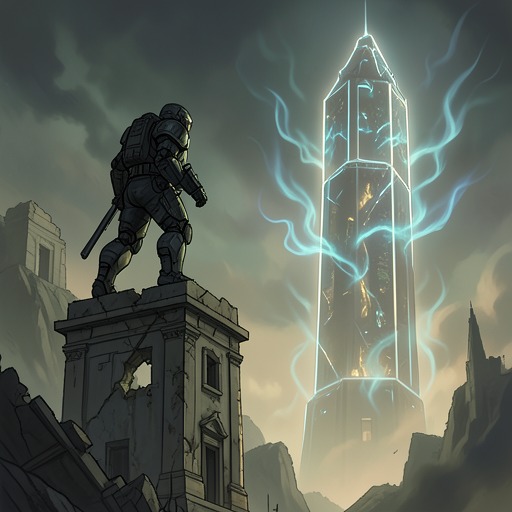
Ahrusk Portal Staging Area
Systema Delenda EstAhrusk Portal Staging Area is the ruined receiving zone on the far side of the portal from Earth, and its destruction marks the first visible clash between Cato’s postbiological counter-invasion and the wider System. Once a camp capable of hosting Gold- and Platinum-rank forces, it is transformed into a blasted frontier landmark: a place where the System’s quest machinery, its military response, and the uncertainty surrounding Cato’s origins all converge.
Setting and Destruction
The staging area is already a wasteland when Cato arrives. Kinetic impactors sent through the portal have torn the camp apart, leaving burnt ground, bubbled glass, molten-edged craters, and charred remnants of wood and clay. Cato’s ten-ton bioweapon frame crosses the wreckage without concern for heat or sharp debris, treating the devastation less as a battlefield to mourn than as an obstacle on a strict timetable. Above him, a close binary casts faintly tinted shadows, an alien visual detail that contrasts with the industrial violence below and confirms that this is not Earth but a frontier world under different skies.
The destruction also makes the area strategically ambiguous. The portal remains important enough to draw System forces, yet the camp itself has been closed and damaged so thoroughly that ordinary military assumptions no longer apply. The devastation is therefore both physical evidence of Cato’s arrival and an information vacuum: responders can see what happened, but they cannot yet determine what kind of force caused it, where it went, or whether the apparent attacker is a single creature or the advance element of a larger invasion.
The Defense Quest and Cato’s Counter-Invasion
The System immediately converts the incursion into a formal task. An Instant Defense Quest directs responders to investigate the incursion at the Ahrusk Portal Staging Area, initially recommending Silver rank and offering a C-Tier Skill as its reward. This framing turns the ruined camp into a lure. The System does not merely register Cato’s presence; it translates the crisis into a game-like opportunity, drawing adventurers toward a location whose real danger exceeds its first listed difficulty.
Cato understands that the System is reacting even while its jamming prevents precise localization. His compromised System interface, installed in the crown of the warframe’s cranium, receives the quest information while specialized sub-brains parallelize his reasoning. When he later reaches a System nexus, the quest has escalated to High Gold and expanded its listed locations to include Southern Jungle Conflict Zone and Gosruk Town. The revision shows that the staging area is not an isolated incident. It is the first node in a widening pursuit, with the System shifting targets and increasing the expected power of the responders as it struggles to contain him.
The camp also exposes Cato’s selective hostility. He does not want to kill System inhabitants who are merely answering a defense call and do not understand the structure they serve. In his view, invaders are legitimate enemies, but ordinary defenders are unfortunate participants in a larger mechanism. The staging area thus establishes the distinction between Cato’s war against the System and his reluctance to treat every System citizen as an enemy.
A Trap for Responders
Raine, Cormok, and Maur arrive after the destruction and read the site through the assumptions imposed by the System. Raine sees the craters and the remains of a camp that had contained Golds and even Platinums; the scale of the missing forces tells her that powers far beyond her party have been involved. Cormok’s Tracking detects only a faint reading, encouraging the mistaken belief that the threat may be manageable. Maur then treats the quest’s Silver recommendation and C-Tier reward as proof that a Gold-ranked party should be able to handle it.
The contrast between the visible ruin and the official quest rating produces the scene’s central reversal. The staging area looks like the aftermath of a major military action, but the System presents it as a comprehensible, reward-bearing assignment. Its interface makes the catastrophe legible as a challenge while concealing the scale of the opponent. The later escalation to High Gold confirms that the original classification was not a reliable measure of danger; it was part of the System’s process for mobilizing participants before the full nature of the threat was understood.
Cato exploits that confusion. After speaking through a puppet and claiming that Cormok did not survive the quest, he triggers the puppet’s self-destruct purge. Its neural mass collapses into charred ash, and the resulting quest update removes Gosruk Town from the location list. Traffic rushes toward the System nexus, drawing attention away from Cato even as he recognizes the cost: Gosruk Town will be traumatized by the event for the foreseeable future. The staging area therefore functions as the origin point of a diversion that redirects the System’s response while preserving Cato’s mobility.
Closure, Politics, and Strategic Consequences
The portal’s closure changes the meaning of the staging area from active gateway to contested remnant. When Onswa explains that the Clans took over the site after the portal became significant, he links its militarization to the disappearance of Sydea’s former strategic insignificance. Before the crisis, there had been no reason to regulate access because Sydea had little to offer. Once the staging area was destroyed and Cato’s quest began attracting opportunists, powerful Clans moved to control the route. The ruins thus generate a political struggle among factions that had previously ignored the frontier.
The closure is also noticed far beyond the immediate battlefield. A priest reports that the quest for the Ahrusk Portal Staging Area no longer exists and that the portal on Sydea has been closed. The report is confused, but it includes a crucial claim: a native associated with the matter says that the System itself is threatened. That rumor travels through System religious and administrative channels, turning a local military disaster into evidence of a systemic danger.
Initik eventually recognizes the larger significance. He learns that Cato comes from outside known reality and seeks the destruction of the System, and he connects that knowledge to the strange essence signature that crossed the portal and triggered his alarms. His investigation of a Sydean frame ends when the subject dies, but the failure only deepens the mystery. Neyar recalls two earlier portal closures, roughly ten thousand and fifty thousand years in the past, both accompanied by rumors of strange encounters and missing high-rankers. Neither precedent, however, involved a population of unusually powerful, visibly varied newcomers or an explicit intention to destroy the System. The Ahrusk route therefore becomes historically anomalous, not merely tactically dangerous.
Legacy as a Frontier Fault Line
The staging area remains important even after direct access is blocked. Nikhil finds the Sydea portal under pressure from incoming factions, while Clan Morkrom Silvers emerge from the route complaining about events on the other side. Later, Raine sees the Kalhan City portal covered by a shimmering golden film that even a Clan Morkrom member cannot penetrate. The sealed gateway fills Nexus buildings with outworlders and forces Raine and Leese to navigate carefully around Clan Tornok forces while they search for Onswa. Closure does not end the crisis; it concentrates displaced people, competing authorities, and unfinished questions at the remaining access points.
Initik concludes that the safest response would be to cut Sydea off from the rest of the System, although he doubts that he can persuade others to accept so extreme a measure. The subsequent proposal to embargo Sydea and close its portals follows the same logic. The Ahrusk Portal Staging Area is therefore the first place where the System’s ordinary assumptions about containment fail. A portal meant to connect worlds becomes a breach through which an external civilization enters, a quest becomes a recruitment mechanism for disaster, and a ruined camp becomes the evidence used to justify isolation.
Its decisive significance lies in that transformation. The area begins as infrastructure, becomes a battlefield, then becomes a political and epistemological fault line. It reveals that the System can register an invasion without understanding it, that its rewards can disguise rather than measure danger, and that the destruction of one frontier gateway can provoke military mobilization, Clan competition, religious alarm, and plans for the quarantine of an entire world.